America's Age of Lynching (1880-1940)


Introduction
This was supposed to be an essay on Jim Crow, covering its rise, heyday, and demise. This will not be that. Early on in my Jim Crow deep dive, I went down a pretty dark rabbit hole on the topic of lynching. Like many Americans, I’d seen some of the disturbing lynching photos, but overall my understanding was woefully lacking. What I learned kind of blew me away. It was more than just angry crowds hanging black men without a trial. There was so much more sadism and racism involved. I kept asking myself, 'Did Americans actually do this to other Americans? Seriously?'
This reaction reminded me, somewhat uncomfortably, of an observation Susan Sontag made in Regarding the Pain of Others, in which she reflected on the kind of person who is "...perennially surprised that depravity exists, who continues to feel disillusioned (even incredulous) when confronted with evidence of what humans are capable of inflicting in the way of gruesome, hands-on cruelties upon other humans, has not reached moral or psychological adulthood." (1) That's a fair point, and it remains relevant today when most of our encounters with violence are usually not firsthand but mediated through the safe distance of a flat screen.
With that in mind, I turn to one of the ugliest chapters in U.S. history: lynching. According to the best estimates, mobs lynched more than 3,200 black people in the South between 1880 and 1940. (2) The South’s share of lynchings rose over the ensuing decades, from 82% in the 1880s to 95% by the 1920s. The regional contrast is striking: outside the South, 83% of lynching victims were white, while within the South, 85% were Black. Lynching historian W. Fitzhugh Brundage noted that lynchings happened throughout American history — for example, vigilante justice in the Wild West was common, and most victims were white — but during the second half of the nineteenth century, it evolved into a Southern and racial phenomenon. (3)
Lynching took many forms. During Reconstruction, it often occurred in the dead of night, carried out by small groups of armed men. However, my main interest here is the subset that became known as public-spectacle lynchings. I confess, it was quite depressing to read about people gathering in large crowds at festival-like settings to witness the torture and murder of another human being, and then posing for photos afterward as if they had just been to Disneyland. These weren't rare events, either. Such spectacle lynchings continued to occur fairly regularly for several decades, mostly (but not only) in the South.
Unfortunately, I came across dozens of lynching accounts that were as horrifying in their violence as they were riveting. For the sake of (relative) brevity, I’ll only focus on three of the most infamous here: one at the beginning (1899), one in the middle (1916), and one near the end (1934). They all share roughly the same sequence of events, which you'll soon pick up on.
Still, I don’t want this to become a gratuitous parade of atrocity porn. There were also people fighting back, and they’re part of this story, too. I'll tell their stories too. For example, starting in the 1890s, Ida B. Wells launched a campaign to expose lynching as mob murder and racial terror, not merely an expression of popular “rough” justice.
Later, others would join the struggle, including W.E.B. Du Bois, James Weldon Johnson, and Walter White, among others. I’ll look at how they confronted lynching and the strategies they used to shift public perceptions. Lynchers portrayed themselves as defenders of women, Christianity, and the purity of the white race, and they used that framing to justify their actions.
Anti-lynching activists reversed this, exposing them as moral monsters and sadists rather than gallant protectors of Western civilization and white feminine virtue. Slowly, all too slowly, this message reached the American public. Many Americans—including a growing number of white Southerners—felt the sting of hypocrisy and shame when a lynching occurred. Modern, civilized, Christian nations did not do such things.
Well, actually, they did.

The Spectacle Lynching of Sam Hose: A Real Community Effort
On April 23, 1899, thousands gathered in the small Georgia town of Newnan to witness the mutilation and burning of a black farmhand, Sam Hose. Eleven days earlier, he had allegedly killed his employer, a farmer named Alfred Cranford, and raped his wife, Mattie.
There was little doubt about what would happen when Hose was caught. No trial would take place. In fact, he had already been tried and condemned by the press, thanks to sensational newspaper coverage that presumed his guilt and sensationalized his crimes in the most titillating ways.
The Atlanta Constitution’s headline on April 14 was “Determined mob after Hose; he will be lynched if caught.” (4) And right under that: “Assailant of Mrs. Cranford may be brought to Palmetto and burned at the stake.”
Every day, ever more dramatic details of the alleged crime appeared in headlines across the state. According to a widely reprinted account by Georgia Congressman James M. Griggs, Hose, a “monster in human form,” had “crept into that happy little home…with an ax knocked out the brains of that father, snatched the child from its mother, threw it across the room out of his way, and then by force accomplished his foul purpose. [He] carried the helpless body to another room, and there stripped her person of every thread and vestige of clothing, there keeping her till time enough had elapsed to permit him to accomplish his fiendish offense twice more and again!” (5)
Whatever happened in the Cranford home, Griggs’s dramatic reconstruction was more fiction than fact. The newspapers covering the case transformed rumors into unchallenged facts before Hose had even been captured, let alone had his day in court.
Two brothers captured Hose near Marshallville on the evening of April 22. It turned out Hose had fled straight to his mother's after the altercation with Cranford. The posse that had spent the last week hunting him had looked everywhere but the most obvious place. His captors tried to deliver him to the authorities in Atlanta to collect the reward money. On the way there, the plan fell apart. Someone recognized Hose on the train and raised the alarm. At the next station, he and his captors were put on a dedicated train back to Newnan, one with only a single coach car reserved for him and his guards. (6)

Hose wasn’t the only one to get a special train that Sunday. In response to customer demand, the Atlanta and West Point Railroad announced additional trains from Atlanta to Newnan to accommodate the surge of riders traveling to witness Hose’s impending immolation. Thousands streamed into Newnan that Sunday afternoon. This would not be some clandestine murder in the woods on a dark night, committed by masked clansmen. No, everyone was invited—come one, come all! (7)
Once Hose arrived in Newnan, local authorities took him to the jail. However, Sheriff Joseph Brown found himself surrounded by a restless crowd gathered for a lynching. Afraid he was about to lose control of the situation, he staged a bit of a charade: he would symbolically lock up Hose for a moment, before stepping away and letting the mob have him.
The plan fell apart on the way to the jail cell. The mob threatened the jailer and seized Hose. William Yates Atkinson, a former Georgia governor, tried to talk the crowd down, to no avail. Whatever flickering hope Hose still entertained of making it through that day disappeared. (8)
The next stop was the home of Mattie Cranford’s parents, where she had been staying since her husband’s death. This was the mob’s planned moment of poetic “justice,” a chance for the victim or the victim’s relatives to take revenge. Not this time, though. Mattie was too distraught to come out, and so the mob moved on to the lynching site. (9)
At some point that afternoon, they let Hose tell his side, though nothing he said would change the outcome. He reportedly admitted to killing Alfred but claimed self-defense after Cranford pulled a gun on him during a pay dispute; he denied the rape charge to the end. It made no difference.
And then it began.
Hose was chained to a tree. A man stepped out of the crowd and sliced off Hose’s ears and fingers. Another man cut off his genitals. Each severed body part was held up for the cheering crowd to see. Hose was soon soaked in his own blood and weeping. After about half an hour of this gruesome torture, someone barked, “Come on with the oil!” Three men poured a can of kerosene over Hose’s body and set him ablaze. His last reported words as the flames engulfed him were “Sweet Jesus!”
The crowd watched him burn. This was the grand finale of the day's spectacle, the reason they had come. In a last, desperate burst of strength, he somehow managed to break free of his bonds and tried to flee the flames. There was no where to run, though. A few men from the crowd grabbed some long boards and pinned him back down in the fire until he was dead. (10)
The New York Tribune reported that, afterward, “the Negro’s heart was cut into several pieces, as was also his liver…Small pieces of bone went for 25 cents and a bit of liver, crisply cooked, for 10 cents.” (11)
The Atlanta Constitution, which just spent the last eleven days painting Hose as “black beast” and “the fiend incarnate,” noted how “the excursionists returning tonight were loaded down with ghastly reminders of the affair…pieces of flesh and pieces of the wood placed at the negro’s feet…Persons were seen walking through the streets carrying bones in their hands.” (12)
Fiends incarnate in many forms, it seems.
And that was that.
Life returned to normal. No one was ever held accountable.
Three weeks later, Newnan's local paper published a reader's dreadful poem about the lynching:
The monster fiend of all the fiends
That ever cursed the earth;
The blackest devil of all his kind—
A devil from his birth!
Then boldly say, “We’ve done no wrong
To burn the monster at the stake;”
But join in peans [sic] and in song
For all that’s dear—for woman’s sake.
That vengeance came from God on high,
To take from earth the hellish fiend;
’Twas but right he should die
With lurid fire to light the same.
’Twill teach these brutal beasts to know
That vengeance dire will quickly come;
God’s righteous wrath is never slow
To avenge the Christian home.
And so ’twill be till cause shall cease
To blight with crime our Southern land;
To take the higher law in hand.
It matters not, black fiend or white,
They’ll surely come to time;
God ordains it just and right
To avenge this hellish crime.
Atlanta, Ga., May 2d. —JUSTICE (13)
This doggerel lacks any hint of doubt or shame about what happened.
That would only come later.
The Birth of an Anti-Lynching Movement
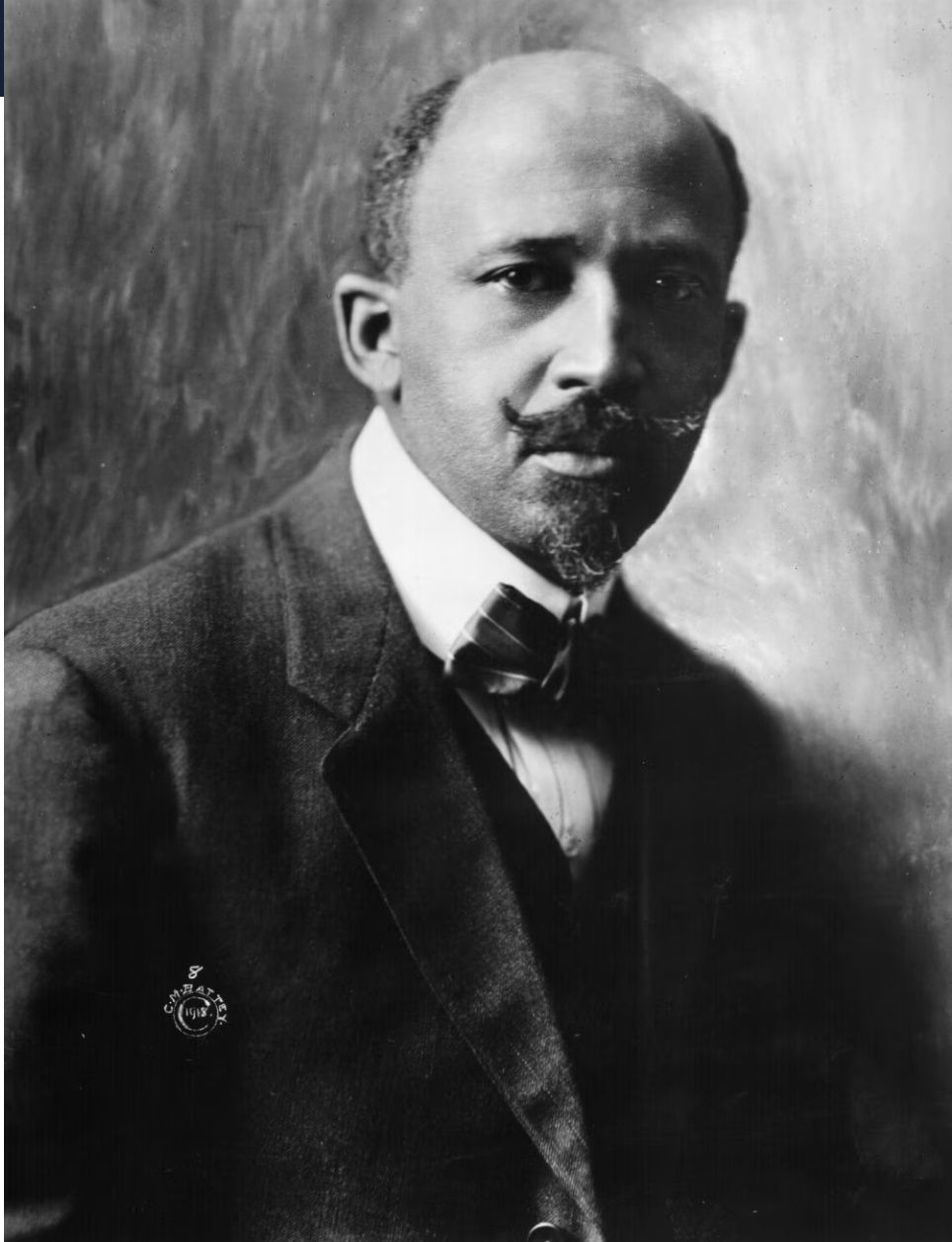
Soon after this, W.E.B. Du Bois, who lived in Atlanta, heard that Hose’s knuckles were for sale at the butcher’s shop down the street. The savagery of the lynching was an epiphany for him. Before, he believed social change might occur through reasoned arguments and rational persuasion. By making white America aware of the injustice black Americans faced in daily life, he appealed to their sense of justice and compassion. Du Bois wrote that “one could not be a calm, cool, detached scientist while Negroes were lynched, murdered and starved.” (14)
The sadism of Hose’s murder, witnessed by thousands of weekend daytrippers from Atlanta who came to see a man tortured and killed, not to mention the gruesome souvenir in the butcher's shop, convinced Du Bois that the problem ran much deeper. “The cure wasn’t simply telling people the truth; it was inducing them to act on it.” (15)
That would prove immensely difficult. The struggle to end lynching continued through the 1930s; the fight against institutionalized racial violence ("legal lynchings") would go on even longer. Du Bois would be at the center of the fight against lynching in the coming years. “Inducing them to act” became the heart of an emerging campaign that eventually evolved into a nationwide effort led by organizations like the NAACP. But that was yet to come.

One of the most prominent and uncompromising anti-lynching figures in the 1890s and early 1900s was Ida B. Wells (1862—1931). Born into slavery in 1862, Wells raised herself up through hard work and intelligence. After her parents and a brother died in a yellow fever epidemic when she was sixteen, she stepped up to raise her five surviving siblings. During the 1880s, she taught at a black elementary school and attended college. She also became an outspoken critic of discrimination. That was something about Wells: she had no reservations about speaking out against racial injustice, even when it brought trouble. She made it her life's work.
She once sued a Tennessee railroad for denying her the right to sit in the first-class ladies’ car, instead of the crowded, smoke-filled car reserved for black riders. Although she won $500 in damages, the railroad appealed to the Tennessee Supreme Court, which in 1887 ruled against her, another example of prejudice triumphing over justice. (16)
In this precursor to Plessy v. Ferguson (1896), the state court held that racial segregation could also mean “separate but equal.” Tennessee’s high court concluded that the ladies’ car and the smoking car (where black passengers sat) were “alike in every respect as to comfort, convenience, and safety.” This was ludicrous. They weren’t ‘alike’ at all. To cap it all, Wells ended up liable for $200 in court costs. (17)
Undaunted, she channeled her energy into journalism, writing for several black publications in Memphis. In 1889, she became editor and co-owner of the Memphis Free Speech and Headlight, commonly known as The Free Speech, which became a vocal critic of local discrimination. In 1892, seven years before Du Bois heard about those knuckles for sale at the butcher’s, Wells had an epiphany of her own following the lynching of three black men associated with The People’s Grocery in Memphis: the three were the store's owner Thomas Moss, who was also a close friend of Wells, the general manager Calvin McDowell, and the clerk Will Stewart.
It all began with a fight between black and white youths over a game of marbles. W.R. Barrett, a white man with a rival store in the same neighborhood, used the scuffle to stir up trouble. (18) The situation soon escalated. When armed sheriff’s deputies raided the store one night, Moss and the men guarding it mistook them for another anticipated white mob. Gunfire followed, and three deputies were wounded. The next day, police arrested Moss, McDowell, and Stewart and held them without bail. Local papers described the black-owned grocery as “a nest of turbulent and unruly Negroes.” (19)
At 3 a.m. a few nights later, a mob broke into the jail and abducted the three men. They were taken to a field north of town, lined up, and shot. Before his murder, Moss supposedly told his killers to “tell my people to go West—there’s no justice for them here.” (20) They hadn’t been accused of rape or murder. Their real offense had been defending a successful black business against a malicious white rival who sought to exploit racial tensions to ruin them.
For Wells, these murders destroyed the Southern justification that lynching was merely a community’s emotional response to violent black sexual crimes against white women. And so she went to war with the one weapon she had: her pen. The white community of Memphis hated her for it. It didn't take long before another mob came and burned the office of The Free Speech to the ground. Fortunately, she was out of town, or she might have suffered the safe fate as the three grocers. She never moved back to Memphis.
Soon after, she published Southern Horrors: Lynch Law in All Its Phases in late 1892, from the safety of New York City. In it, she debunked the myth that lynchings were solely the result of “black beasts” raping innocent white damsels. Indeed, most weren’t about rape at all. She argued that lynching was a tactic meant to terrorize black people, cow them into subservience, and keep them in poverty. That, and nothing more.
She went further, contending that many so-called rapes were actually consensual relationships between white women and black men. For many white racists of the era, this was unthinkable. Lynching became a way to use terror to uphold America’s racial caste system. Historian Philip Dray credits Wells with being one of the first in America to call attention to the fact that “the talk of [white] chivalry and beastlike blacks ravishing white girls was largely fallacious.” (21)
She was also outraged by the spiritual hypocrisy of white Southerners who could sit in church one day and burn a man to death the next, or, in Hose’s case, on the same day. To her, this revealed a stunning moral blindness. She once wrote: “Our American Christians are too busy saving the souls of white Christians from burning in hell-fire to save the lives of black ones from present burning in fires kindled by white Christians.” (22)
Wells also understood the importance of sending independent investigators to the sites of lynchings to get the other side of the story. After Hose’s death, Wells and others from the Chicago black community commissioned Detective Louis P. Levin to go to Newnan. He spoke with black and white residents in the Newnan area to gather their accounts of the events. He uncovered context that hadn’t been reported before Hose’s murder.
The version he uncovered revealed that Hose’s mother was ill, prompting the young man to ask his employer, Cranford, for an advance on his pay so he could visit her. Cranford refused and began verbally abusing Hose. A physical altercation ensued, during which Hose killed Cranford. Afterward, Hose fled. In this telling of events, he never saw Mattie Cranford, let alone raped her, as newspapers alleged. (23)
According to the investigator’s report, Mattie didn’t initially report the rape. That allegation only appeared later and was embellished by the media. That doesn’t mean it didn’t happen. There are other reasonable explanations for Mattie’s belated claim of rape, such as a deep sense of embarrassment about it going public. That said, we’ll never know for sure what occurred that day, since Mattie's voice in the historical record falls silent after this. Moreover, the other person there on that day, Sam Hose, was dead, and so he would never be given a fair trial to separate fact from fiction.
Levin’s report named names, condemning W.A. Hemphill and Clark Howell, respectively, the president and editor of The Atlanta Constitution: “Through the columns of their paper, they exaggerated every detail of the killing, inventing and publishing inflammatory descriptions of a crime that was never committed, and by glaring headlines continually suggested the burning of the man when caught.” Levin concluded, “I made my way home thoroughly convinced that a Negro’s life is a very cheap thing in Georgia.” (24)
Hose’s murder in 1899 capped the worst decade of lynching in American history. On average, one occurred somewhere in the U.S., usually in the South, every few days. However, people like Wells and others were more determined than ever that the mob and its complicit newspapers would not be the only ones telling the story.

Birth of the NAACP and its Early Campaign Against Lynching
Although effective for its time, Wells’ campaign was relatively small in scale and reach. This changed in 1909 with the founding of the National Association for the Advancement of Colored People (NAACP). The catalyst was the 1908 race riot in Springfield, Illinois (Abe Lincoln’s hometown), in which a white mob attacked the city’s black community and lynched two men. (25)
This helped inspire an interracial coalition of black activists and white progressives that became the NAACP. The new organization soon had nationwide reach devoted to fighting discrimination and racial violence. Although Wells participated in the NAACP’s founding, disagreements over personality, tactics, gender, and control of the movement soon pushed her to the margins. (26)
W.E.B. Du Bois, one of the NAACP’s co-founders, served as editor of its flagship magazine, The Crisis, from 1910 to 1934. By 1918, the publication had a national circulation of 100,000. (27) It was an important forum for black culture and remained a fierce critic of lynching. The group conducted its own investigations and published reports based on its findings, institutionalizing the investigative methods pioneered by Wells. The Crisis also featured cartoons and satire that mocked and called out a nation that would permit extra-legal killings on its soil.
Du Bois and the NAACP recognized the critical role of language in shaping public perceptions. They built on Wells’s work by shifting attention away from the alleged crimes of lynching victims. Such accusations often left the public ambivalent about mob violence and receptive to rationalizations of “rough justice.”
NAACP coverage instead decentered the identity of the lynching victim and centered instead on the lynchers’ criminality and cruelty. By reframing them as the villains, the NAACP meant, as Philip Dray put it, “to rub America’s face in the gritty business of hanging, shooting, and roasting defenseless human beings.” (28)
Mary White Ovington, a socialist, suffragette, and one of the NAACP’s founders, was equally blunt about how the campaign would be waged: “It was necessary to shake the nation out of its complacency and to superimpose on the picture of the black brute… the picture of the white brute, taking his pleasure in a bestiality that we now understand only too well, and that we have learned to fear as we fear nothing else.” (29) Some lynching victims may have been guilty of serious crimes; yet others were plainly innocent of the accusations against them. But guilt wasn't the point. Every lynching prioritized the mob’s violence over investigation, trial, and legal judgment.
A 1911 lynching in Livermore, Kentucky, offered the NAACP an early test of its strategy. There, Will Porter, who was black, shot and wounded a white man during a barroom altercation. Accounts differ widely on what followed. According to The New York Times, the sheriff arrested Porter soon after the shooting. As an angry mob was forming, the sheriff hid his prisoner in the opera house basement.
Nonetheless, the mob uncovered the ruse, stormed the opera house, and seized Porter. They dragged him upstairs, tied him to a pole on the stage, and shot him to death. The Times reported, “Of about 200 shots fired, nearly half entered the body of the black man and the remainder tore to shreds the woodland scenery arranged for the presentation of a much milder drama.” (30)
The NAACP conducted an independent investigation and sent the findings to major newspapers nationwide, as well as to Kentucky Governor Augustus Willson and President Taft. Willson urged prosecutors to act. In the end, 18 men were indicted, but only three went to trial. All three were acquitted, making this only a partial victory for the NAACP’s pressure campaign.
While it may have appeared like more of the same in the South, these were early signs that tolerance for such killings was beginning to wane among both the public and policymakers. Livermore showed that a lynching could no longer remain a purely local affair. Although the NAACP attracted national attention and pressured elected officials to act, it still couldn’t make local white juries convict.
There was still a lot of work to do.

“The Waco Horror”
One of the most infamous lynchings in American history (and that’s saying something) was the 1916 lynching of 17-year-old Jesse Washington in Waco, Texas. He was accused of raping and murdering Lucy Fryer, a white woman, on May 8. Sheriff Fleming recognized the very real danger of an imminent lynching, and so he pushed to hold the trial as soon as possible.
He assumed that a rapid trial would lead to an equally rapid legal execution. Few doubted that Washington would be found guilty and sentenced to death. In other words, this was a mob-prevention strategy. Authorities also hoped that an early trial, conviction, and legal execution would bring a sense of justice to the community and head off the ugliness of a lynching. (31)
The trial happened only a week later. An armed and unruly mob packed the courtroom. Washington’s worthless court-appointed attorney challenged no jurors, called no witnesses, and waived closing argument. The entire trial lasted about an hour. The jury deliberated for just over four minutes and returned a guilty verdict with the death penalty. (32)
With this mockery of justice out of the way, all hell broke loose.
The courtroom mob seized Washington. He was stripped, kicked, stabbed, and led through the crowded streets before being forced, bloody and naked, to a bonfire prepared beside a tree in front of City Hall. At that point, a crowd of thousands had gathered.
A few men from the crowd chained Washington to a tree and hoisted him into the air. Then he was lowered, and his fingers, ears, toes, and penis were cut off. Finally, someone doused him with coal oil and set him ablaze. Afterward, someone lassoed his charred remains and dragged them through the streets behind a horse. The gruesome finale to this spectacle came when the crowd rushed forward to snatch body parts as souvenirs. Also, violent spectacles like this often came with an entrepreneurial element. In this case, Fred A. Gildersleeve took photographs of the lynching to sell as postcards. (33)

However, those photographs became ammunition for the NAACP’s response. The organization sent Elisabeth Freeman to Waco to investigate afterward. To get people to open up, she posed as a sympathetic journalist seeking to tell Waco’s side of the story. She found locals conflicted about what had happened. Not about lynching—many seemed untroubled by that. But the torture and burning alive, along with dragging the charred corpse through the streets, offended some locals’ sensibilities. The general sentiment she encountered went something like, “If only they had just hung him." (34)
If only.
Freeman submitted a detailed report, and W.E.B. Du Bois assembled an eight-page supplement for the July 1916 edition of The Crisis. It was titled “The Waco Horror.” More controversially, the magazine also published photos of Washington’s charred remains. Du Bois’s coverage and the Gildersleeve photos horrified the nation. (35)
None of this was flattering to Waco’s leaders, who saw their city disgraced by what had happened. That was the intent. The NAACP meant to use all the means at its disposal to shame and expose communities like Waco that condoned lynchings. The NAACP sent the Waco Horror article to President Wilson, Congress, and newspapers across the country. Freeman went on a speaking tour that raised more than $10,000 for the organization to fund future investigations and lobby for federal anti-lynching legislation. (36)
Historian Amy Louise Wood notes that Washington’s death “represents a defining moment, an instance when the spectacle of lynching began to sow the seeds of its own collapse.” (37) The NAACP helped accelerate a shift toward more critical national coverage of lynching.
Wood concluded: "From the mid-1910s through the 1930s, the NAACP and the black press’s concerted efforts to disseminate and publish lynching photographs rendered the South, along with what were perceived as its backward and degenerate punitive practices, the object of a critical national gaze.” (38)
This wasn’t the end of lynching. Mobs would continue to kill with impunity (though less frequently) for a few more decades. However, communities began to grasp that such lynchings would receive negative coverage in the press. The NAACP couldn’t make those white juries convict lynch mob participants, but it would expose their actions for the world to see.
The Fight for Anti-Lynching Legislation
Throughout the 1920s, the annual number of lynchings continued to decline nationally. Several other factors account for this trend. Many Southern business elites were embarrassed when lynchings occurred in their communities. (39) That no doubt played some role. Historians Tolnay and Beck note that these same local elites had launched a “selling the South” campaign in the 1920s to encourage investment and tourism in the region. Lynching was antithetical to that program.
As they put it: “Pictures of a black corpse, charred and chained to a tree, or of mobs of grinning white men and boys surrounding the body of a black man hanging by a rope, were not the best images to promote investment and economic development.” (40)
No, they were not.
While the NAACP’s efforts undoubtedly contributed to the decline, economic factors and urbanization also played important roles. This period coincided with the Great Migration, when 1.3 million black people left to seek better opportunities in the North or to flee Jim Crow in the South. (41)
Whatever the reasons for this shift, the NAACP concluded that federal legislation was necessary to end lynching once and for all. A major part of the organization's long-term strategy was the passage of a national anti-lynching law. This would prove to be an elusive goal.
First introduced in 1918 and passed by the House in 1922, the Dyer Anti-Lynching Bill would have made lynching a felony, enabling federal prosecution of state or local officials who failed to protect prisoners from mobs. It would also have penalized mob participants and fined counties where lynchings occurred. President Harding supported the bill. He described lynching as a “very sore spot on our boast of civilization.” In a 1921 speech to Congress, he made his position clear: “Congress ought to wipe the stain of barbaric lynching from the banners of a free and orderly, representative democracy.” (42)
That said, some Southern congressmen vehemently opposed it for blatantly racist reasons. Representative Hatton Sumners of Texas described lynching as an expression of “racial instinct.” He went on: “When men respond to that call, they respond to a law that is higher than the law of self-preservation. It is a call to the preservation of the race. When that call comes, every man who is not a racial degenerate has to answer it." Such arguments no longer resonated with many Americans. The Dyer Bill passed the House by a vote of 230 to 119. (43)
The Senate would be another matter. In the coming years, it would prove to be the biggest obstacle to passing any legislation. Spearheading the NAACP’s lobbying campaign was James Weldon Johnson, a lawyer, writer, and former U.S. diplomat. He joined the NAACP in 1916 and played a key role in building local branches across the country and expanding membership. Johnson provided congressional committees with lynching statistics and newspaper reports. Just as importantly, he cultivated political allies in Congress, helping ensure the bill remained a priority in the House. As the bill moved to the Senate, Johnson highlighted several recent lynchings as grim reminders of the need for this law.
For example, after the recent murder of a seventeen-year-old white girl, three black men (“Snap” Curry, Mose Jones, and Johnny Cornish) were lynched in Kirvin, Texas. Before their arrest, however, the girl’s father pointed the finger at a neighboring white family he was feuding with. He even pleaded with the sheriff not to let any local blacks take the blame for the crime, since he worried that they would be the first suspects.
Well, that’s exactly what happened. The sheriff arrested the three, who proclaimed their innocence. You can probably guess where this is going. A mob soon formed, broke into the jail, and took them to a secluded spot where they were tortured and murdered. The newspaper euphemistically described how “no organ of the Negroes was allowed to remain protruding.” (44)
In November 1922, just before the Senate vote on the Dyer Bill, the NAACP placed full-page ads in eight of the country’s largest newspapers, including the New York Times, the Washington Post, and The Atlanta Constitution. The headline, in large, bold letters, read “THE SHAME OF AMERICA” (45)

It wasn’t enough. A determined filibuster by Southern Democratic Senators derailed the bill. To avoid jeopardizing the rest of their legislative agenda, Republicans withdrew it. Dray notes that although the bill didn’t pass, it kept the issue on people's minds. Though Johnson helped secure House passage and make lynching a national issue, he wasn't able to break the Senate coalition that protected Southern control over racial policy (46)
The Final Years of Spectacle Lynching - Claude Neal, 1934
The next major push to pass anti-lynching legislation came in the early 1930s. By then, the annual number of lynchings had fallen dramatically from its peak in the 1890s, but the few that remained were often as sadistic as those from decades earlier. Take, for example, the gruesome killing of Claude Neal in October 1934 in the Florida Panhandle.
Neal was accused of the rape and murder of a nineteen-year-old white girl, Lola Cannidy. He was arrested on circumstantial evidence and allegedly confessed to the killing after repeated interrogations without an attorney present. Sheriff Chambliss tried to keep his prisoner safe by moving him between jails in Alabama and Florida. He was right to do so. A group of 100 vigilantes, traveling in a caravan of vehicles, roamed the countryside in search of Neal’s whereabouts. (47)
The pursuers eventually caught up with him at a jail in Brewton, Alabama. They stormed it, seized Neal, and brought him to Marianna, Florida. The Dothan Eagle, a newspaper in nearby Dothan, Alabama, announced the mob’s intent to lynch Neal. (48) A Dothan radio station broadcast that “all white people” were invited. (49) As with the Hose lynching, everyone kind of knew how it would play out. It was no secret. Yet the authorities did little to stop it.
Walter White, the NAACP’s head at the time, tried to intervene to save Neal from his grisly fate. He sent a telegram to Florida Governor Sholtz urging him to “take every possible step to avoid this disgrace upon the state of Florida.” (50) White, a seasoned NAACP investigator, knew where this was headed. He’d investigated dozens of lynchings and recognized all the signs.
Governor Sholtz decided not to act because the sheriff (who had already lost Neal, by the way) assured him that the situation was under control. It most certainly was not.
The mob had planned to take Neal to the farm where Lola’s parents lived and to let them take their vengeance however they saw fit. An expectant crowd of one or two thousand had gathered for the show. However, the crowd’s size (thanks to all the media) and drunken unruliness spooked the mob’s leaders, who had dubbed themselves “The Committee of Six.”
They decided to keep Neal tucked away in the nearby woods for the time being. For his part, Lola's father, George Cannidy, couldn’t wait to get his chance at Neal, though he didn’t want the murder to happen on his property because he feared Neal would “haunt” him. Instead, they tried to move the killing site to a nearby location. Still, most of the crowd followed, presumably because they didn't want to miss out on the lynching they'd come to see. (51)
Around 10 p.m. that night, those holding Neal resolved to lynch him then and there, even before the Cannidys arrived. But they didn't plan to just kill Neal. They wanted him to suffer first. Many in the mob were already drunk, and the anticipation of the impending violence became irresistible. NAACP investigator Howard Kester interviewed participants and recorded what happened next. It makes for really grim reading. (52)
According to Kester's report, they hanged Neal to the point of death, then lowered and revived him. Then the torture began. "Then they sliced his sides and stomach with knives and every now and then somebody cut off a finger or toe." Red-hot irons burned his body "from top to bottom." Not only were his testicles and penis cut off, but he had to eat them and say he liked it. (53) Around midnight, someone finished Neal off with a 12-gauge shotgun blast. (54)
.
Neal’s battered remains were taken to the Cannidy farm. The corpse became the wrathful focus for those who had missed out on the torture and killing, especially Lola’s parents, who felt betrayed by this turn of events. They'd been promised, after all, first shots at Neal. Mr. Cannidy emptied his revolver into the lifeless body as soon as he saw it. Mrs. Cannidy then took her turn, plunging a steak knife into the heart. The crowd then vented its frustrations by stomping and urinating on the corpse.
Afterward, a car dragged the body (or what was left of it) into town, where it was hanged in front of the Confederate statue in the courthouse yard. Souvenir hunters arrived to cut pieces from Neal’s corpse. Photographs of Neal’s battered remains went on sale as postcards. (55) When authorities refused to hang Neal’s body again for more ghoul-gazing, there was almost a riot. The violence soon spilled over, and members of the crowd attacked innocent black residents and property before the governor belatedly called in the National Guard to restore order. Better late than never, but not really in this case. Late was about the same as never.
In the end, a grand jury concluded that the murder was committed by “persons unknown to us.” No one was ever indicted.
White believed that Neal’s violent death provided further evidence of the need for federal anti-lynching legislation. Clearly, Southern leaders couldn’t handle the problem on their own. They hadn’t. They never would, it seemed. It kept happening. To hammer that point home, White pointed out the 277 lynchings in the decade since the Dyer Bill’s failure. (56)
White, building on the powerful networks James Weldon Johnson had established before him, won Eleanor Roosevelt’s support. Unfortunately, he didn’t have FDR’s public endorsement. FDR privately condemned lynching but wasn’t willing to risk his New Deal legislative agenda by alienating several key Southern Democrats in the Senate. He needed their help to push through his other priorities. I'm speculating a bit here, but my sense is that FDR made the cold calculation that his broader New Deal agenda was more important to more Americans than legislation meant to solve a problem that seemed to be (slowly) resolving itself on its own. After all, lynching was in the midst of a long historic decline, while the economic turmoil of the Depression was still very real. In any case, his silence effectively doomed the bill. (57)
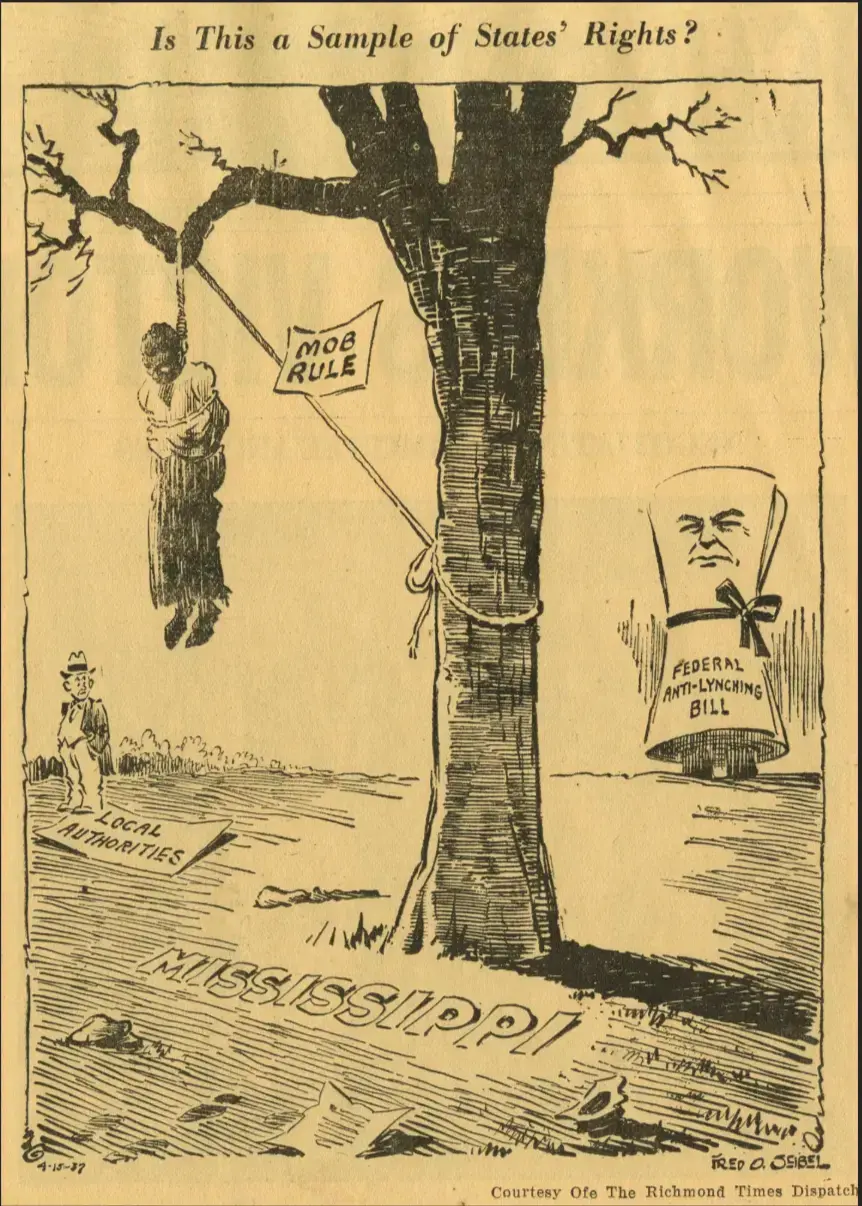
Still, they gave it a shot. Neal’s murder gave the Costigan-Wagner anti-lynching bill some momentum in Congress. However, a bloc of Southern senators kept it from coming to a vote. Congress tried again two years later. The final Wagner-Van Nuys bill easily passed the House 277-120 but couldn’t survive a determined Senate filibuster led by Texas Senator Tom Connally. During that filibuster, Louisiana Senator Allen J. Ellender pontificated for an epic twenty-seven hours and forty-five minutes about the “mongrelization” of the white race if blacks were given social equality. (58)
This was a reminder that a relatively small but steadfast bloc in positions of power could still thwart legislative change. While that may be true, defenders of lynching had lost the public debate. A 1937 Gallup Poll found that 72% of Americans, including 57% of Southerners, agreed on the need for either state or federal laws criminalizing lynching. (59)
In the end, no federal anti-lynching law passed until the Emmett Till Antilynching Act in 2022, almost a century later.

Final Thoughts
By the late 1940s, lynchings were so rare that groups like the NAACP could focus most of their efforts on desegregation and the overturning of Jim Crow. The Civil Rights movement that would sweep the nation in the coming decades began to take shape at this time. Public lynchings had mostly disappeared, but violence against black people persisted in other forms.
Take fourteen-year-old Emmett Till from Chicago, for example, who was murdered in August 1955 during a summer visit with relatives in Mississippi. What happened that day in Bryant’s grocery store is disputed, but Till was accused of making sexual advances toward Carolyn Bryant, a white, married 21-year-old who worked behind the counter.
A few nights later, her husband, Roy Bryant, and his half-brother, J.W. Milam, abducted Till from his great-uncle’s house. They took him to a remote location, where they beat and shot him to death. The killers dumped the body in the Tallahatchie River, which was only found three days later. The two killers were arrested, charged, and, as usual, acquitted by an all-white jury just a month later.

His grieving mother, Mamie Till Mobley, took a page from the anti-lynching playbook, forcing the public to confront what racial violence looked like and what it still meant to be black in America in the middle of the twentieth century. She did so by leaving her son’s casket open at the funeral so everyone could see for themselves. “Let the people see what they did to my boy,” she declared. (60)
A lot had changed since Sam Hose’s murder half a century earlier, but an ugly truth lay in that coffin: Black people could be killed with impunity, while the white perpetrators of such violence rarely faced accountability. That was the case here.
Safe from the law, the two sneering scumbags who killed Till sold their story to Look Magazine for $4,000. In January 1956, the magazine published the story in which the two admitted to abducting and murdering Till. The white community that had backed them throughout the trial now ostracized them. Black residents refused to shop in Bryant's store, which soon went out of business. They paid a social cost, though not nearly enough. (61)
Earlier in this essay, I discussed an awful poem that celebrated the lynching of Sam Hose. I’ll close with a far better one that condemns it. I’m talking about "Strange Fruit," a poem originally written by Abel Meeropol, a Jewish high school English teacher from the Bronx. He later set it to music. He was among those moved by the photos he’d seen of a 1930 lynching in Indiana.
Legendary singer Billie Holiday was moved by this poem and began performing it as the concert’s final song, after which the lights would fade to black. It was reported that people sometimes got up and left in protest when she sang "Strange Fruit."
But she sang it anyway.
Endnotes
(1) Susan Sontag. Regarding the Pain of Others, 114.
(3) Fitzhugh Brundage. Lynching in the New South: Georgia and Virginia, 1880-1930, 8.
(4) Atlanta Constitution, 14 April, 1899.
(5) Philip Dray. At the Hands of Persons Unknown: The Lynching of Black America, 4.
(6) Donald Mathews. At the altar of lynching: Burning Sam Hose in the American South, 155.
(7) Dray, 13.
(8) Mathews, 158.
(9) Dray, 11-12.
(10) Dray, 13.
(11) Tolnay and Beck. A Festival of Violence, 23.
(12) Dray, 14.
(13) Herald & Advertiser, Newnan, Georgia, 12 May, 1899.
(14) Dray, 15.
(15) Dray, 15.
(16) Mia Bay. To Tell the Truth Freely, 52.
(17) Bay, 54.
(18) Bay, 83.
(19) Dray, 61.
(20) Bay, 85.
(21) Dray, 64.
(22) Wood, 52.
(23) Dray, 16.
(24) Dray, 16.
(26) Dray, 172.
(27) Dray, 186.
(28) Dray, 177.
(29) Dray, 177.
(31) Dray, 217.
(32) Dray, 217.
(33) Dray, 218.
(34) Dray, 218.
(36) Wood, 182.
(37) Wood, 179.
(38) Wood, 183.
(39) Wood, 182.
(40) Tolnay & Beck, 245.
(41) Tolnay & Beck, 214.
(42) Dray, 259.
(43) Dray, 264-266.
(44) Dray, 269.
(46) Dray, 270-271.
(47) Dray, 347.
(48) Dray, 347.
(49) Kenneth Janken, White: The Biography of Walter White, 214.
(50) McGovern 102.
(51) McGovern, 76-80.
(52) McGovern, 76-79.
(53) McGovern, 83.
(54) Dray, 349.
(55) Dray, 350.
(56) Dray, 336.
(57) Dray, 355-356.
(58) Dray, 360.
(59) Justin McCarthy. “Gallup Vault: 72% Support for Anti-Lynching Bill in 1937.” Gallup.com.
Works Cited
Bay, Mia. To tell the truth freely. New York, Godalming: Hill and Wang ; Melia distributor, 2010.
Brundage, W. Fitzhugh. Lynching in the New South: Georgia and Virginia, 1880-1930. Urbana: University of Illinois Press, 1993.
“Claude Neal – Notice to Close File.” Civil Rights Division | Claude Neal – Notice to Close File | United States Department of Justice, April 18, 2023. https://www.justice.gov/crt/case-document/claude-neal-notice-close-file.
“Determined Mob after Hose: He Will Be Lynched If Caught.” Atlanta Constitution. April 4, 1899.
Dray, Philip. At the hands of persons unknown: The lynching of black America. Modern Library Paperback Edition, 2003.
Du Bois, W.E.B., ed. “The Waco Horror, July 1916.” University of Massachusetts Amherst. Accessed September 13, 2026. https://credo.library.umass.edu/view/full/mums312-b163-i124.
Finnegan, Terence. A deed so accursed: Lynching in Mississippi and South Carolina, 1881-1940. Charlottesville: University of Virginia Press, 2013.
“Getting Away with Murder.” PBS. Accessed September 13, 2026. https://www.pbs.org/wgbh/americanexperience/features/emmett-biography-roy-carolyn-bryant-and-jw-milam/.
Janken, Kenneth Robert. White: The biography of Walter White, Mr. NAACP. New York: New Press, 2003.
Lobel, Michael. “Battle Lines.” Artforum, September 26, 2023. https://www.artforum.com/columns/michael-lobel-on-romare-bearden-in-the-1930s-251245/.
Lynched on stage; shots came from pit; mob ... Accessed September 13, 2026. https://www.nytimes.com/1911/04/21/archives/lynched-on-stage-shots-came-from-pit-mob-took-negro-from-marshal.html.
Mathews, Donald G. At the altar of lynching: Burning Sam Hose in the American South. New York, NY, USA: Cambridge University Press, 2018.
McCarthy, Justin. “Gallup Vault: 72% Support for Anti-Lynching Bill in 1937.” Gallup.com, March 26, 2025. https://news.gallup.com/vault/234371/gallup-vault-support-anti-lynching-bill-1937.aspx.
McCarthy, Justin. “Gallup Vault: 72% Support for Anti-Lynching Bill in 1937.” Gallup.com, March 26, 2025. https://news.gallup.com/vault/234371/gallup-vault-support-anti-lynching-bill-1937.aspx.
McGovern, James R. Anatomy of a lynching: The killing of Claude Neal. Baton Rouge, La: Louisiana State University Press, 1992.
Moma | one way ticket: Jacob Lawrence’s migration series. Accessed September 12, 2026. https://moma.org/interactives/exhibitions/2015/onewayticket/panel.
Pfeifer, Michael J. Rough justice: Lynching and American Society, 1874-1947. Urbana, Ill.: University of Illinois Press, 2006.
“Sam Holt.” Herald & Advertiser. May 12, 1899.
“The Shame of America.” newyorktimes.com. Accessed September 13, 2026. https://timesmachine.nytimes.com/timesmachine/1922/11/23/issue.html.
Sontag, Susan. Regarding the pain of others. New York: Picador, 2010.
“Springfield 1908 Race Riot National Monument (U.S. National Park Service).” National Parks Service. Accessed September 13, 2026. https://www.nps.gov/spra/index.htm.
Staff, Sun-Times. “Battered Body of Till Boy Arrives Here; Murdered Youth’s Kin Hysterical at Station.” Times, September 2, 1955. https://chicago.suntimes.com/1955/9/2/23837892/emmett-till-news-battered-body-of-till-boy-arrives-here-murdered-youths-kin-hysterical-at-station.
Tolnay, Stewart Emory, and E. M. Beck. A festival of violence: An analysis of southern lynchings, 1882-1930. Urbana: University of Illinois Press, 1995.
White, Walter. Rope and faggot: A biography of Judge Lynch. Notre Dame, Ind, New York: University of Notre Dame Press ; Wiley, 2002.
Wood, Amy Louise. Lynching and spectacle: Witnessing racial violence in America, 1890-1940. Chapel Hill: University of North Carolina Press, 2011.
----
PDW
Dry Grove, Illinois
13 Sep 2026